
Related Posts
- ▶ What to Inspect in Beiyi Steel Hot Rolled Plate Packing Before Ocean Dispatch
- ▶ How Beiyi Steel Protects Hot Rolled Plates from Moisture During Ocean Shipping
- ▶ Will Transit Rust on Galvanized Steel Coil Qualify for Replacement?
- ▶ How thick should wear resistant steel plate be for abrasive service?
- ▶ How should galvanized steel coil be stored to prevent white rust?
- ▶ Steel Production Capacity Soars with Technological Advancements and Strategic Investments
Send Us A Message
Does a PPGI steel coil need a specified coating thickness?
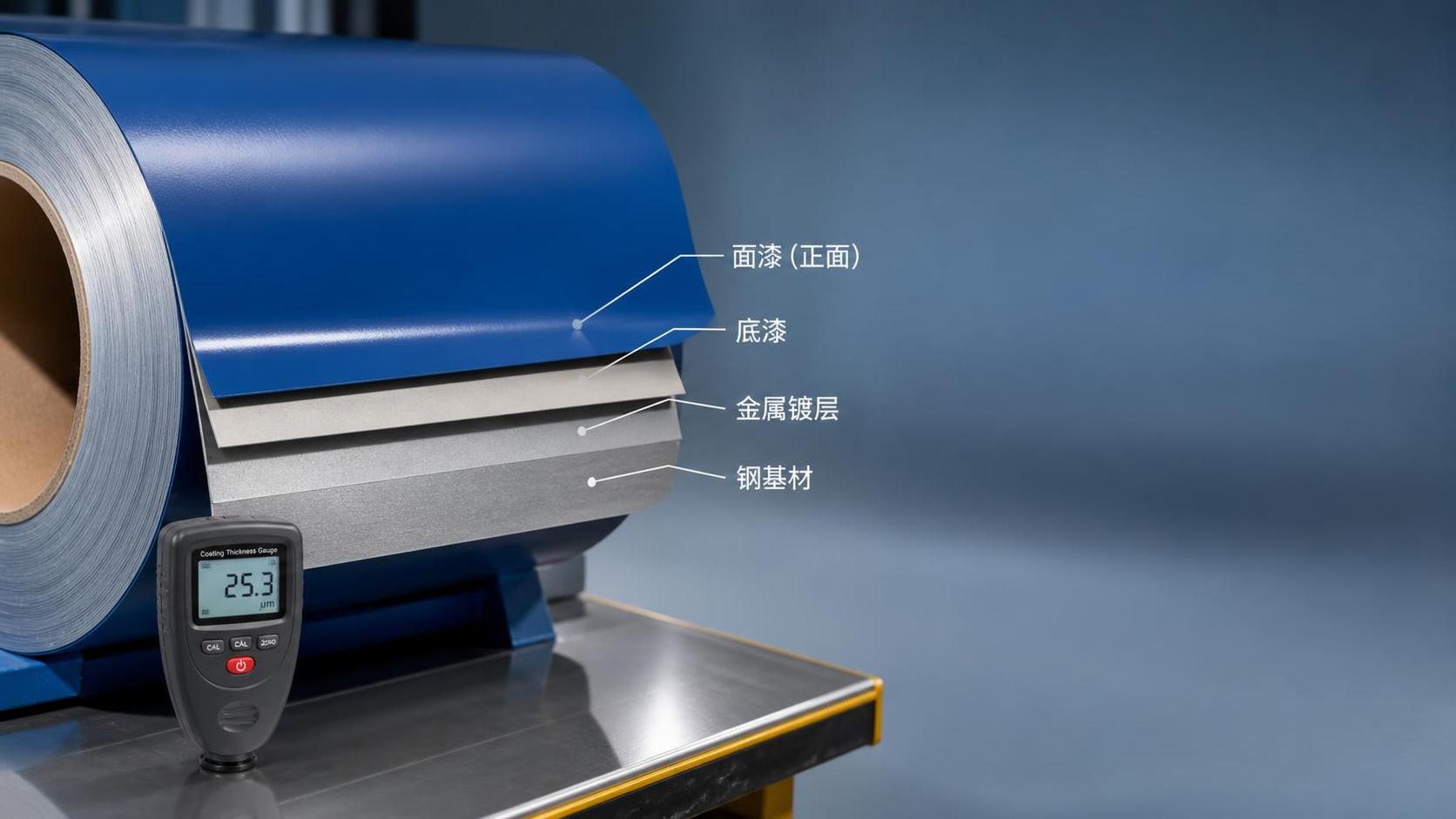
For technical evaluators, specifying the right coating thickness for a PPGI steel coil is not a minor line item. It is one of the decisions that determines whether a finished panel keeps its appearance and protective function in service—or begins to show premature fading, edge corrosion, cracking, or blistering.
The short answer is yes: in most technically controlled projects, a PPGI steel coil should have a specified coating thickness. Yet the requirement should not be written as a single universal number. Paint thickness is only meaningful when it is connected to the metallic coating, paint chemistry, coil processing route, exposure environment, forming severity, and intended service life.
A request such as “PPGI, 25 microns” may appear clear, but it can still leave important questions unanswered. Is 25 μm the nominal top-coat thickness or the total dry-film thickness? Does it include primer? What is required on the reverse side? Is the substrate galvanized steel or galvalume steel? What minimum thickness is acceptable at local measurement points? Without those details, two coils with the same quoted coating thickness may perform very differently after installation.
Coating Thickness Is Usually Worth Specifying—But Specify the Right Layer
PPGI, or pre-painted galvanized iron/steel coil, normally consists of several functional layers rather than one paint film. A typical construction includes:
- A steel substrate;
- A metallic corrosion-protection coating, commonly zinc or zinc-aluminium alloy;
- Surface treatment or chemical pretreatment;
- A primer coat;
- A finish coat on the exposed side;
- A back coat on the reverse side.
When buyers refer to “coating thickness,” they may mean either the metallic coating mass or the organic paint film thickness. These are separate specifications and should never be treated as interchangeable.
For example, a galvanized substrate may be designated by a zinc coating mass such as Z100, Z180, or Z275, depending on the applicable standard and the product configuration. This figure relates to the zinc layer on both sides of the steel, generally expressed in grams per square metre. The paint system, by contrast, is normally described in microns (μm) of dry-film thickness, often with separate values for the top side and reverse side.
A technically complete procurement requirement therefore identifies both elements: the metallic coating designation and the paint system with its nominal thickness and tolerance. If only one is specified, the other may become an uncontrolled variable.
Why a PPGI Steel Coil Cannot Be Judged by Microns Alone
Thicker paint is often associated with better protection, and in some situations that is true. A sufficiently robust film can improve barrier protection, reduce the chance of pinholes, provide more weathering reserve, and maintain appearance for longer in demanding environments. But thickness alone is not a guarantee of durability.
A 25 μm polyester finish and a 25 μm PVDF-based finish do not offer identical resistance to ultraviolet exposure, chemical attack, chalking, or colour change. Likewise, a thicker coating applied over poor pretreatment may fail earlier than a thinner, well-adhered system on a properly prepared substrate.
The evaluator should consider coating thickness as one part of a performance package. The relevant package includes:
- Paint chemistry: polyester, SMP, HDP, PVDF, polyurethane, plastisol, or another system;
- Primer type and thickness: important for adhesion and corrosion resistance;
- Metallic coating: zinc, zinc-aluminium, or aluminium-zinc alloy;
- Pretreatment quality: particularly critical at cut edges and formed areas;
- Colour and gloss: dark colours and high-gloss finishes can show degradation differently from light, matte finishes;
- Forming demand: roofing profiles, deep bends, and roll-formed sections place different stress on the film;
- Local environment: rural, urban, industrial, coastal, tropical, high-UV, or chemically exposed.
In other words, coating thickness should be specified because it matters, but it should not become a shortcut for evaluating the entire coating system.
What Should Be Written in a Technical Specification?
The most useful specifications remove ambiguity before the coil reaches a production line. Rather than stating only “paint thickness 20 μm,” define the paint construction and the method of assessment.
A practical specification for a PPGI steel coil may include the following points:
- Steel grade, base metal thickness, and dimensional tolerances;
- Metallic coating type and mass designation;
- Top-side paint system, including primer and finish-coat chemistry where required;
- Nominal top-side dry-film thickness;
- Back-coat type and nominal thickness;
- Permitted local minimum or thickness tolerance;
- Colour reference, gloss range, and surface finish;
- Adhesion, bend, impact, hardness, and solvent-resistance requirements;
- Corrosion and weathering test requirements appropriate to the project;
- Applicable standard, inspection basis, and sampling plan.
For a conventional building sheet, a commonly encountered arrangement may use a finish coat and primer totaling roughly 20–25 μm on the weather side, with a lighter back coat on the reverse side. This is not a universal recommendation. In more severe coastal, industrial, or high-UV conditions, a different chemistry, a heavier film build, a more protective metallic coating, or all three may be justified.
The key is to distinguish between nominal thickness and minimum measured thickness. Coil coating is a continuous industrial process. Minor variation across the strip width and along the coil is expected. If a project needs a guaranteed minimum at every measured point, that requirement must be explicitly agreed with the supplier because it is not identical to a nominal target value.
Top Coat, Primer, and Back Coat: Do Not Leave the Reverse Side Undefined
Technical discussions often focus entirely on the visible face of a PPGI steel coil. That makes sense for architectural appearance, but the reverse side is frequently where hidden trouble begins.
The back coat may face condensation inside a roof system, humid air in a warehouse, insulation materials, trapped moisture, or contact with construction debris. A basic service coating may be suitable where the reverse side remains dry and protected. It may be inadequate where there is persistent condensation or a corrosive internal atmosphere.
For sandwich panels, ceiling applications, agricultural buildings, food-processing surroundings, and ventilated but humid structures, the reverse-side coating should be reviewed as seriously as the top side. Thickness matters here, but compatibility with foam, adhesive, insulation, and installation conditions may matter just as much.
The primer should also be treated as a functional layer, not merely a hidden one. It promotes adhesion between the pretreatment and finish coat, contributes to corrosion resistance, and supports flexibility during profiling. A final paint thickness figure without primer information can conceal a weak coating build-up.
Environmental Severity Should Drive the Requirement
It is tempting to create one internal PPGI specification for every project. That approach simplifies purchasing, but it can create two opposite risks: under-specification in harsh environments and unnecessary cost in benign ones.
For low-pollution inland applications with moderate humidity, a standard polyester-coated coil on an appropriate galvanized substrate may provide a reasonable balance of appearance and cost. In this setting, an excessively heavy premium coating system may not generate proportionate value.
Conditions change rapidly near the sea, however. Chlorides accelerate corrosion, especially at cut edges, overlaps, fastener locations, scratches, and areas where water remains trapped. A thicker top coat may help, but the decision should also account for the metallic coating, paint system, roof geometry, drainage, and maintenance access. Coastal performance is not solved by adding a few microns to a standard paint film.
Industrial areas deserve similar care. Sulphur compounds, cleaning chemicals, airborne contaminants, and process emissions can challenge organic coatings in ways that ordinary atmospheric exposure does not. High-UV locations create a different concern: colour retention, gloss retention, chalking, and film integrity may become more important than simple salt-spray resistance.
Where exposure is uncertain, the evaluator should request a clear environmental classification from the project team and align it with the relevant coating standard or manufacturer performance data. European projects commonly refer to EN 10169 for continuously organic-coated flat steel products, while ASTM A755/A755M is widely used in North American specifications. JIS G3312 may be relevant for Japanese-market colour-coated steel. These documents provide useful frameworks, but they do not eliminate the need to define the actual service environment.
Thickness Measurement: A Small Inspection Detail with Major Consequences
A coating thickness requirement only has value when inspection methods are agreed in advance. For organic coatings on ferrous substrates, magnetic or electromagnetic dry-film gauges are commonly used. The instrument should be calibrated using suitable shims or reference standards, and readings should be taken at an agreed number of locations.
Measurement on a finished coil requires care. The result can be affected by surface texture, gloss, profiling, local paint flow, and the underlying metallic coating. Measurements should generally be made on flat areas, away from coil edges, scratches, wrinkles, or handling marks. If a coil is later roll formed, the coating will be under strain at bends, so pre-forming thickness alone does not confirm final coating integrity.
A good inspection plan records more than an average. Average values can hide isolated thin areas that become early corrosion sites. Evaluators should ask:
- How many readings are required per coil or per lot?
- Are measurements taken across the strip width as well as along its length?
- Is acceptance based on average thickness, individual readings, or both?
- Are top and reverse sides checked separately?
- Will coating thickness be verified before dispatch, upon receipt, or after forming?
Certificates of conformity or mill test documentation can provide useful traceability, but they should support—not replace—an appropriate incoming inspection programme for critical applications.
Common Specification Mistakes
Confusing zinc mass with paint thickness. A zinc designation and a paint-film figure describe different protective layers. Listing “Z275 / 25 μm” is clearer than stating one figure without identifying what it represents.
Specifying only a total coating thickness. A total dry-film thickness does not reveal the split between primer and finish coat. It also says nothing about the reverse side.
Using a premium thickness with a low-demand paint system. If a project requires long-term colour stability under intense sunlight, paint chemistry may be more decisive than adding thickness to a standard polyester system.
Ignoring cut-edge corrosion. Organic coating does not fully cover freshly cut edges. Substrate coating, edge design, drainage, overlap details, and exposure conditions all influence edge durability.
Failing to consider fabrication. A coil that performs well as a flat painted strip can crack during aggressive roll forming if flexibility, T-bend performance, and adhesion are not matched to the profile design.
Setting an unrealistically tight tolerance. Overly restrictive thickness tolerances may raise cost and reject material that is functionally acceptable, without providing meaningful field-performance improvement.
A Better Decision Framework for Technical Evaluators
Instead of beginning with a preferred micron value, begin with the project’s failure consequences. Is this coil intended for a temporary enclosure, a residential roof, a façade panel, a refrigerated building, an agricultural structure, or equipment housing? Is appearance expected to remain stable for many years? Can panels be replaced easily? Will the reverse side see condensation? These questions bring the correct technical priorities into focus.
Then define the exposure level, select a compatible substrate and metallic coating, choose the paint chemistry, and establish the coating thickness range needed for that system. Finally, confirm that the coil can survive the planned forming operation and that the inspection criteria are measurable.
That order prevents a familiar purchasing mistake: comparing offers only by base-metal thickness, zinc designation, and top-coat microns. Two quotations may look comparable on paper while differing in primer quality, back-coat build, paint chemistry, pretreatment, or test criteria.
Conclusion
A PPGI steel coil does need a specified coating thickness when durability, appearance, and corrosion resistance matter. The specification, however, should be more thoughtful than a single number. Define the top-side and reverse-side film build, identify whether figures are nominal or minimum, separate paint thickness from metallic coating mass, and connect the entire coating system to the intended environment.
For technical evaluators, the most reliable approach is to specify performance and construction together. A well-chosen PPGI coating thickness is not simply more paint on steel; it is a controlled balance between protection, formability, visual expectations, service conditions, and cost over the life of the finished product.
DROP A MESSAGE