
Related Posts
- ▶ What to Inspect in Beiyi Steel Hot Rolled Plate Packing Before Ocean Dispatch
- ▶ How Beiyi Steel Protects Hot Rolled Plates from Moisture During Ocean Shipping
- ▶ Will Transit Rust on Galvanized Steel Coil Qualify for Replacement?
- ▶ How thick should wear resistant steel plate be for abrasive service?
- ▶ How should galvanized steel coil be stored to prevent white rust?
- ▶ Steel Production Capacity Soars with Technological Advancements and Strategic Investments
Send Us A Message
How does a steel pipe supplier affect project delivery risk?
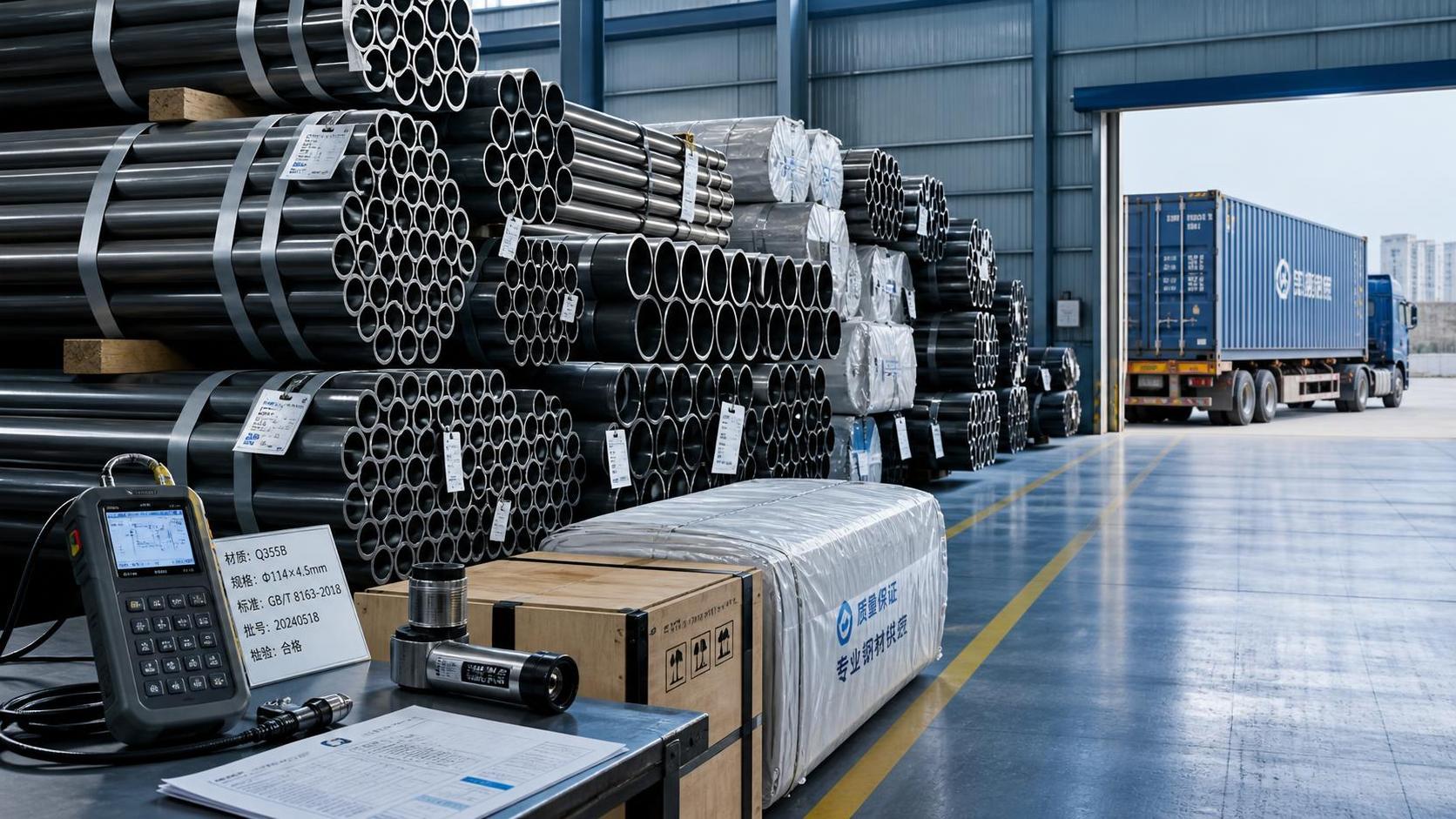
On many engineering projects, steel pipe is treated as a straightforward procurement item: confirm the specification, obtain quotations, issue a purchase order, and wait for delivery. In reality, the choice of a steel pipe supplier can shape far more than the cost of a material package. It can affect fabrication sequencing, site installation, inspection approvals, cash flow, safety exposure, and the credibility of the project team when commitments to the owner begin to slip.
The risk rarely arrives as one dramatic failure. More often, it begins with a missing heat number on a material certificate, a delivery split without notice, a mismatch between ordered and supplied wall thickness, or a supplier who stops answering technical clarification emails when the schedule becomes tight. Each issue may look manageable on its own. Together, they can create a chain reaction: welding is delayed, work fronts sit idle, equipment cannot be commissioned, and expediting costs rise when there is little room left to recover.
For project managers and engineering leaders, supplier selection is therefore not simply a commercial decision. It is a delivery-risk decision.
Why steel pipe supply has an outsized effect on project delivery
Steel pipe often sits at the intersection of several disciplines. It may be needed for process piping, utility systems, structural works, water transmission, fire protection, piling, or mechanical assemblies. Before it can be installed, the project may need to verify dimensions, grade, coating condition, end preparation, traceability, test documentation, and compatibility with fittings or welding procedures.
That dependency makes pipe procurement unusually sensitive to small disruptions. A late shipment of general consumables may be absorbed by a project team. A late shipment of a specified pipe size, however, can hold up associated flanges, bends, valves, supports, insulation, pressure testing, and commissioning activities. If that pipe is part of a critical path system, the impact extends beyond the pipe itself.
A capable steel pipe supplier does not remove all uncertainty from a project. Market shortages, port congestion, changes in design, and force majeure events can still happen. What the supplier can do is make uncertainty visible early, document the true status of supply, and respond in a way that gives the project team choices rather than surprises.
The delivery risks hidden behind a low quotation
When bids are compared mainly on unit price, the commercial saving can conceal exposure elsewhere. A supplier with a lower offer may be quoting from uncertain mill availability, relying on unconfirmed third-party stock, or excluding testing, coating, marking, packaging, and documentation that the project assumes are included.
This does not mean the lowest-priced supplier is automatically unsuitable. It means the quote needs to be read as a delivery plan, not just a price sheet.
Availability risk: “In stock” may not mean ready to ship
Pipe availability needs to be defined carefully. Material can be physically available but still unavailable for the project because it has not been inspected, cut to length, coated, bundled, certified, or released by the mill. Some suppliers use “stock” to describe material held within a broad trading network rather than in a controlled warehouse.
For a project team, the meaningful questions are more specific: Is the exact grade, outside diameter, wall thickness, and length available? Is the quantity reserved? Is it from one production lot or multiple lots? Can it be dispatched after required inspection? Are certificates already available and traceable to the delivered bundles?
Availability risk becomes acute when a project requires non-standard sizes, heavy wall pipe, low-temperature grades, alloy materials, large diameters, or specific coating systems. In these cases, the supplier’s access to mills and its ability to secure production slots matter more than a polished catalogue.
Documentation risk can stop installation even when the pipe is on site
Material test certificates, inspection reports, packing lists, coating records, and traceability markings are not administrative extras. On many projects, they are release documents. If the certificates do not match the heat numbers, do not state the required standard, or arrive after the materials have been unloaded and mixed with other stock, the site team may have no defensible basis for installation.
Documentation errors also create rework in the quality process. Engineers may spend days reconciling bundle numbers with certificates. Inspectors may request additional tests. Materials can be quarantined while crews wait. The physical product may be perfectly usable, but without acceptable evidence, it becomes unusable to the project.
A reliable steel pipe supplier should be able to explain how material identity is preserved from mill receipt through cutting, processing, storage, and shipment. That explanation should be supported by a practical document-control process, not vague assurances that paperwork will follow.
Quality variation creates schedule risk before it becomes a defect claim
When pipe dimensions, ovality, straightness, end finish, coating condition, or chemical composition vary beyond project requirements, the first consequence is often lost time. Fit-up becomes difficult. Welding productivity drops. A coating repair process is introduced. Field modifications multiply. Even where the material is ultimately accepted, the installation plan has already been disturbed.
This is why quality should be evaluated in terms of operational consequences, not only pass-or-fail compliance. A supplier that consistently delivers pipe with clear markings, protected ends, suitable packaging, and predictable dimensional condition reduces friction at the receiving yard and the workface.
Logistics risk is often a communication problem in disguise
Projects can plan around a known delay better than around an unknown one. The serious risk is not always that a truck, vessel, or container is late; it is that the project hears about the delay too late to resequence work, activate backup supply, adjust fabrication, or notify the client.
Suppliers should provide shipment status that reflects reality: confirmed collection dates, loading status, expected arrival, partial shipment details, and any changes to the agreed plan. A delivery date without a defined shipping basis is weak information. A project manager needs to know whether the date refers to mill completion, warehouse release, port departure, or arrival at the jobsite.
A supplier’s response speed matters most when conditions change
Steel procurement is rarely static. Engineering revisions may alter quantities or wall thicknesses. A construction team may discover that a priority spool requires an earlier delivery. An inspector may raise a question about certificates. A shipping route may become impractical. These are ordinary project events, but they reveal whether a supplier is contributing to control or adding to confusion.
Response speed is not simply answering an email within an hour. It includes the ability to provide an informed answer: what material is affected, what inventory is available, whether substitution is possible, what approval is required, and how the revised plan changes cost or lead time.
A supplier that has strong commercial communication but weak technical coordination can become a bottleneck. Project teams should look for evidence that sales, quality, logistics, and warehouse functions can work from the same order information. When those functions operate separately, a small change request can turn into a cycle of contradictory updates.
How to assess a steel pipe supplier before award
The most useful supplier evaluation does not rely on a single score or a generic vendor questionnaire. It tests the supplier against the conditions that make the specific project vulnerable. A municipal water project, an industrial plant shutdown, and an offshore fabrication package will not carry the same risk profile.
Start by mapping what would cause real disruption. Is the project exposed to a narrow installation window? Does it require full material traceability? Are there long-distance transport constraints? Is the design still evolving? Is there a high penalty for late commissioning? The answers should shape both the evaluation criteria and the purchase order.
Check technical understanding, not just standards listed on a website
Ask the supplier to confirm the complete requirement in a controlled offer: applicable material standard, grade, dimensions, tolerances, manufacturing method where relevant, end type, coating or surface condition, lengths, testing, marking, inspection level, and documentation package. Ambiguity at bid stage tends to reappear later as a variation, delay, or dispute.
It is also sensible to review how the supplier handles deviations. A responsible supplier will identify conflicts or unclear requirements before production and offer alternatives with their implications clearly stated. A risky supplier may simply agree to everything, then raise exceptions after the order is placed.
Examine supply-chain visibility
A project manager does not need to know every detail of a supplier’s internal purchasing process. But the supplier should be able to distinguish between material it owns, material reserved from a mill, material available through a trader, and material that still needs to be produced.
For critical packages, request a realistic manufacturing and delivery schedule with key checkpoints. These may include mill allocation, production completion, testing, inspection release, coating completion, packing, dispatch, and expected site arrival. The value is not in creating paperwork for its own sake. It is in identifying where the schedule could fail and when corrective action remains possible.
Review past performance through evidence, not marketing claims
Rather than asking whether the supplier is “reliable,” ask for relevant evidence: examples of similar standards or sizes supplied, a sample certificate package with sensitive details removed, a typical packing list, an explanation of nonconformance handling, and references where appropriate. The goal is to see whether the supplier’s stated process can withstand project scrutiny.
Be cautious about assuming that a large supplier is automatically low risk or that a smaller specialist is automatically high risk. Scale may offer buying power and broader inventory; a specialist may provide closer technical attention and faster decisions. The right choice depends on the project’s material complexity, delivery geography, and need for control.
Build risk controls into the purchase order
Supplier selection is only the first defense. A well-chosen supplier can still struggle if the order lacks clear milestones, acceptance requirements, and escalation routes. Procurement documents should translate the project’s critical concerns into measurable obligations.
For example, the order can define required certificates before shipment, heat-number traceability expectations, agreed delivery lots, packaging requirements, notice periods for schedule changes, inspection hold points, and rules for substitutions. Where partial deliveries are useful, identify which quantities or sizes are priority items rather than leaving the supplier to decide what to ship first.
For high-risk materials, consider a pre-shipment document review. Catching a certificate mismatch before the truck leaves the warehouse is far less costly than discovering it after material has been distributed around a construction site.
It is equally important to establish a single point of contact on both sides and a regular reporting rhythm that matches the project phase. Weekly updates may be adequate during mill production; more frequent updates may be appropriate close to dispatch or during a shutdown window. Reporting should highlight exceptions, not merely repeat that the order is “in progress.”
Common procurement mistakes that increase exposure
- Ordering too late because lead time is treated as production time only. Total lead time also includes technical clarification, inspection, documentation, packing, transportation, receiving, and material release.
- Accepting broad substitutions without engineering review. A similar grade or dimension may change welding requirements, pressure performance, corrosion resistance, or connection compatibility.
- Separating pipe, fittings, and accessories into disconnected purchasing decisions. Savings on one package can disappear when materials do not arrive in an installable sequence.
- Failing to define what “delivery” means. Delivery to port, to a local warehouse, and to the project laydown area are different commitments with different risks.
- Waiting for a problem before involving quality and logistics teams. Cross-functional review at the start is usually cheaper than emergency expediting at the end.
When a dual-source strategy is worth considering
For standard pipe sizes with broad market availability, dual sourcing can reduce dependence on one supplier and provide leverage if schedules change. Yet it also introduces risks: mixed traceability systems, variation in finish or dimensions, more document review, and potential inconsistencies in coating or manufacturing route.
Dual sourcing works best when the project deliberately divides quantities, application areas, or delivery phases and maintains a common technical baseline. It is less effective when used as an unplanned reaction after the primary supplier has already fallen behind. By then, alternative material may not match the approved specification or may require fresh inspection and engineering review.
A practical decision test for project leaders
Before awarding a pipe package, ask one question that goes beyond price: If this supplier encounters a problem three weeks before our required delivery date, will they give us enough accurate information and workable options to protect the project?
The answer comes from their preparation before award. Do they understand the specification? Can they show the actual source and status of material? Are their documents organized? Do they explain limitations honestly? Can they describe how they manage quality incidents and shipment changes? A supplier that is transparent during the bid stage is more likely to be manageable when pressure rises.
The best steel pipe supplier for a project is not necessarily the one with the lowest initial quotation or the broadest promise. It is the supplier whose technical capability, supply visibility, documentation discipline, and communication behavior fit the project’s real exposure. That choice gives project managers something more valuable than a cheaper purchase order: a more predictable path from procurement to installation and final handover.
DROP A MESSAGE